 Home
HomeThe Innovation Paradox in Hardware
Hardware development presents a fundamental paradox: the most innovative products often require the most conservative execution. Revolutionary features demand rock-solid fundamentals. Novel user experiences require reliable underlying technology. Breakthrough designs need proven manufacturing processes.
Innovation without execution kills products. A wearable with groundbreaking biometric sensing fails if battery life doesn't meet user expectations. An IoT device with revolutionary connectivity features fails if it can't maintain stable wireless connections in real environments. A consumer product with innovative industrial design fails if manufacturing costs exceed what markets will pay.
Conservative execution without innovation creates commodities. Products that work reliably but offer nothing new compete purely on price. Manufacturers with better supply chains or lower labor costs win those battles. Innovation provides the differentiation that justifies premium pricing, attracts early adopters, and creates market positions defensible against cheaper competitors.
The successful path combines both: innovative solutions to real problems, executed with discipline that ensures products actually work. When Dysol developed the GlideFinger smart ring, the innovation wasn't cramming sensors into a tiny form factor—plenty of companies have attempted that. The innovation was creating a ring people would actually wear daily by solving the unglamorous problems: wireless charging that works reliably, battery life measured in days not hours, firmware that doesn't crash, and manufacturing processes that produce consistent quality at scale.
Phase 1: Innovation Through Problem Understanding
The best hardware innovations start not with technology but with deep understanding of problems worth solving:
Beyond Surface-Level Problems
Most product development begins with solutions searching for problems. "What if we added AI?" "What if it had a touchscreen?" "What if it connected to smartphones?" These technology-first approaches create products nobody needs.
Innovation starts with understanding problems users actually experience. Not problems they report in surveys—people are terrible at articulating their real needs. Problems revealed through observation of actual behavior, frustrations expressed indirectly, and workarounds people develop when existing solutions fail.
When we developed the Baby Rocker, the innovation wasn't adding motors to infant products—motorized baby products already existed. The innovation came from understanding that parents need products that work reliably at 3 AM when they're exhausted, that clean easily after inevitable messes, that don't require reading instruction manuals, and that fail safely when anything goes wrong. These insights shaped every design decision: simple controls requiring no thought, materials surviving repeated cleaning, safety timeouts preventing misuse, and backup manual operation when electronics fail.
Identifying Constraints That Drive Innovation
Constraints drive innovation more effectively than unlimited resources. The best solutions emerge when forced to work within tight boundaries:
Cost constraints force creative problem-solving that expensive approaches avoid. When you can't afford the premium sensor, you find ways to extract more information from cheaper alternatives through clever signal processing. When you can't use exotic materials, you design geometries that achieve performance through form rather than expensive substance.
Size constraints demand integration and efficiency that spacious designs never achieve. Cramming functionality into compact form factors requires eliminating everything non-essential, optimizing every cubic millimeter, and finding elegant solutions that waste no space.
Power constraints on battery-operated products force ruthless efficiency. Every milliwatt matters. Features that seem essential get cut when they drain batteries. Clever firmware strategies that seemed unnecessary become mandatory. Power constraints breed innovation in ways unlimited wall power never does.
Manufacturing constraints shape innovation toward solutions that actually scale. Designs requiring skilled manual assembly don't work at volume. Tolerances tighter than manufacturing equipment can achieve create quality problems. Constraints force innovative designs that build reliably rather than clever designs that build inconsistently.
For the Smart AC Control, power constraints weren't an issue—mains powered devices have abundant energy. The constraint was thermal management in compact enclosures mounted near heat sources. This drove innovative passive cooling designs using strategic air gaps and thermal mass positioning. Cost constraints prevented using premium microcontrollers, forcing firmware optimization that squeezed functionality from modest processors. These constraints drove innovations that made the product better, not compromises that made it worse.
Phase 2: Innovative Architecture and System Design
Once problems and constraints are clear, innovation happens through thoughtful system architecture:
Modular Design Enables Iteration
The most innovative hardware architectures embrace modularity enabling independent development and testing of subsystems:
Electrical modularity separates functions onto distinct circuit boards or modules that interconnect through well-defined interfaces. Power supply modules can be swapped or upgraded without touching sensor circuits. Communication modules can change from WiFi to cellular without redesigning the entire system. Modularity enables parallel development—mechanical engineers work on enclosures while electrical engineers refine circuits while firmware developers write code.
Mechanical modularity separates products into assemblies that manufacture independently and combine during final assembly. Snap-together designs enable quick assembly and disassembly for service. Modular mechanical design enables different product variants sharing common platforms, reducing development costs across product lines.
Firmware modularity through abstraction layers and well-defined interfaces enables testing modules independently before integration. Hardware abstraction layers let firmware development proceed before final hardware exists. Modular firmware architecture enables reusing proven code across products rather than starting from scratch each time.
When we designed the Lunavii Bracelet, modular architecture proved essential. The wearable band separated into distinct modules: sensor module (accelerometer, proximity detection), communication module (BLE radio), power module (battery, charging), and mechanical closure. Each module developed independently with clear electrical and mechanical interfaces. Problems in one module didn't block progress on others. Manufacturing could source modules from different suppliers or change suppliers without redesigning the entire product.
Leveraging Existing Technology Innovatively
Innovation doesn't require inventing everything from scratch. Often the most innovative solutions combine existing technologies in novel ways:
Off-shelf components provide proven, reliable building blocks. Sensors, processors, communication modules, and mechanical components exist for most common functions. The innovation comes from integration, not reinvention. Using automotive-grade components in consumer products provides reliability without developing custom parts. Adapting industrial sensors for medical applications leverages proven technology in new contexts.
Open-source platforms accelerate development by providing starting points rather than blank slates. ESP32 and Nordic nRF52 platforms include extensive libraries, reference designs, and community knowledge. Building on these foundations enables focusing innovation on product-specific challenges rather than solving problems thousands of others have already solved.
Reference designs from component manufacturers provide proven circuits and layouts. Starting with manufacturer reference designs and adapting them to specific needs reduces risk and accelerates development. The innovation comes from integration and optimization, not rediscovering what component manufacturers already know.
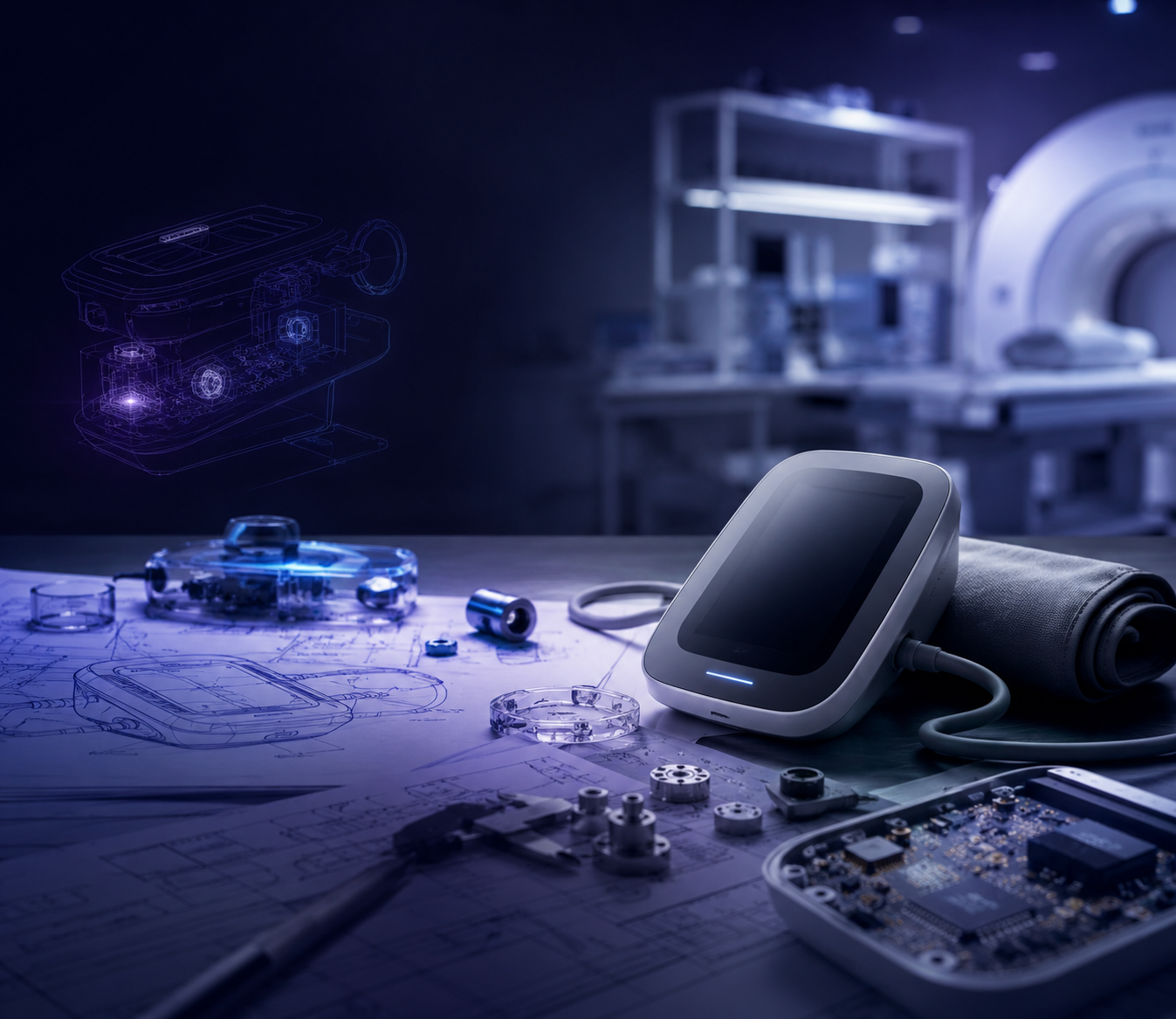
The Smart Blood Pressure Monitor combined off-shelf pressure sensors, reference analog circuits from sensor manufacturers, proven BLE stack from Nordic, and standard lithium battery technology. None of these elements were innovative individually. The innovation was integration into a medical device meeting accuracy requirements, passing certification testing, and achieving acceptable cost at production volumes.
Phase 3: Prototyping Innovation
Innovative products require extensive prototyping, but the approach to prototyping shapes what innovations survive:
Rapid Iteration Over Perfect Planning
The fastest path to innovative products goes through many quick iterations rather than extensive upfront planning attempting perfection:
Build to learn rather than building to impress. Early prototypes should answer specific questions cheaply: Does this sensor work? Can users understand this interface? Does this mechanism survive repeated use? Ugly prototypes that generate learning matter more than beautiful prototypes that look impressive but teach nothing.
Fail fast and cheap. Ideas that won't work should fail during early prototyping when changes cost little. Waiting to discover fundamental problems until after investing in production tooling turns small issues into expensive disasters. Design experiments that can fail without destroying budgets or timelines.
Test in realistic conditions early. Laboratory testing finds obvious problems but misses issues that only appear in real-world conditions. Temperature extremes stress electronics. Vibration fatigues mechanical assemblies. User behavior diverges from designer expectations. Testing in realistic conditions early reveals problems while solutions remain inexpensive.
For the Agricultural Computer Vision Drone Platform, rapid prototyping meant mounting cameras and processors on commercial drones with 3D-printed brackets and zip-tied cables. These prototypes looked terrible but answered critical questions: Could we capture usable images during flight? Would vibration blur images? Could processors handle real-time inference? Would outdoor temperature extremes cause failures? Learning these answers early shaped the entire development direction.
Innovation Through User Testing
The most valuable prototypes put products in actual users' hands:
Observe behavior, not opinions. What users say they want differs from what they actually use. Watching people interact with prototypes reveals true usage patterns, unexpected difficulties, and features they value versus features they ignore.
Test edge cases and misuse. Users do things designers never imagine. They press buttons in wrong sequences. They operate devices in environments never intended. They misunderstand interfaces in ways that seem impossible. User testing reveals these patterns before they become field failures and negative reviews.
Iterate based on actual problems. User feedback generates infinite feature requests and improvement suggestions. Most aren't worth implementing. Focus on solving actual problems users demonstrate rather than implementing everything they suggest. The problems that frustrate multiple users during testing will frustrate thousands after launch.
When we tested Baby Rocker prototypes with parents, observation revealed problems surveys never would: parents tried to adjust rocking speed while holding babies, making two-handed controls impractical. Parents forgot to turn off the device after moving babies to cribs, wasting battery. Parents cleaned spills immediately but struggled with devices requiring disassembly. These observations drove design changes that made the product genuinely useful rather than theoretically clever.
Phase 4: Manufacturing Innovation
Innovation dies when products can't manufacture economically. Manufacturing-focused innovation ensures brilliant designs become successful products:
Design for Manufacturing From Day One
The most innovative products integrate manufacturing considerations throughout development:
Component selection considers availability, lead times, and sourcing stability alongside technical specifications. The perfect component helps nothing if perpetually backordered or discontinued next year. Innovation sometimes means achieving performance goals with more readily available components through clever design.
Assembly process design considers who builds products and with what equipment. Automatic assembly demands designs enabling robotic manipulation and placement. Manual assembly requires designs workers can build without extensive training or specialized fixtures. Innovation in assembly design often delivers more value than innovation in component technology.
Tolerance management through design rather than manufacturing precision reduces costs and improves yield. Parts designed with generous tolerances that still achieve functional requirements cost less to manufacture and assemble more reliably than parts demanding tight tolerances. Innovation in tolerance allocation delivers economic benefits without compromising performance.
Testing and quality control designed into products rather than added afterward ensures quality while minimizing manufacturing costs. Products with built-in test points enable rapid functional verification during assembly. Self-test features allow automated quality screening. Designs enabling simple, fast testing reduce manufacturing costs and improve quality simultaneously.
The GlideFinger smart ring demanded extreme miniaturization requiring innovative manufacturing approaches. We designed the PCB as flex-rigid construction enabling electronics to conform to curved ring geometry. Component placement considered hand assembly—even micro-components positioned for human assembly rather than requiring expensive pick-and-place equipment for small volumes. The charging dock used pogo pins with generous alignment features enabling consistent contact despite manufacturing variation. Every design decision considered whether it could actually be built reliably.
Scaling Innovation
Products that work as handbuilt prototypes often fail during production scale-up:
Pilot production validates manufacturability before committing to volume tooling. Building 50-100 units using production processes reveals problems invisible during prototype development. Assembly times that seemed acceptable building five units per day become bottlenecks at production volumes. Quality issues appearing occasionally during prototyping become unacceptable defect rates at scale.
Supply chain resilience ensures critical components remain available. Single-source components create vulnerability when suppliers encounter problems. Designing with multiple approved sources for critical parts provides insurance against supply disruptions. Sometimes the innovative solution is designing products around commodity components rather than exotic parts with single suppliers.
Cost optimization at volume requires different approaches than prototype costing. Volume purchasing changes component economics dramatically. Tooling costs amortize across production quantities making investments viable at scale that make no sense for prototypes. Understanding these economics shapes design decisions differently than prototype-focused thinking.
Phase 5: Innovation in User Experience
Technical innovation matters little if users don't understand or value it:
Intuitive Interfaces for Complex Functions
The most innovative user interfaces make complex functions feel simple:
Progressive disclosure reveals complexity gradually as users need it rather than overwhelming them upfront. Basic functions work immediately without configuration. Advanced features exist for users who need them without cluttering interfaces for users who don't.
Affordances and feedback communicate device state and available actions without requiring instruction manuals. Buttons should look pressable. Indicators should clearly communicate meaning. Haptic feedback confirms actions. Visual, audible, and tactile feedback create understanding without requiring reading documentation.
Error recovery designed into products enables users to fix problems without support calls. Clear error indicators help users understand what's wrong. Recovery procedures built into interfaces enable fixing problems independently. Products that fail gracefully and recover easily create better user experiences than products requiring perfect operation.
For the Smart AC Control, user interface innovation meant eliminating complex configuration. The device works immediately after plugging in—no app installation required, no WiFi setup wizards, no account creation. LED patterns communicate status at a glance. Single button control enables manual operation without understanding connectivity. App connectivity adds features for users who want them without punishing users who don't.
Packaging Innovation and Unboxing Experience
First impressions shape user perception of product quality:
Unboxing sequences that guide users naturally through setup create positive first experiences. Products positioned for immediate visibility when opening packaging. Quick-start guides immediately visible. Accessories organized logically. The innovation is choreographing user experience from box opening through first use.
Packaging protection that survives shipping while minimizing waste demonstrates care for both product and environment. Custom-designed inserts protect products during shipping using minimal material. Packaging materials that users can easily dispose of or recycle reduce environmental impact.
Documentation innovation through visual guides rather than dense text manuals helps users succeed. Quick-start guides with illustrations and minimal text help users begin immediately. Detailed documentation available online for users who need it. QR codes linking to video tutorials for complex procedures.
Case Study: Innovation Across Product Lifecycle
The Lunavii Bracelet demonstrates innovation across the complete product development lifecycle:
Problem understanding innovation: Rather than creating another fitness tracker, we focused on solving specific parental concerns about child safety through location awareness and activity monitoring. This focus shaped everything that followed.
Technical innovation: Custom circuit board design integrated BLE radio, accelerometer, proximity detection, and battery management into a form factor small enough for children's wrists while achieving multi-day battery life. Pogo pin charging eliminated fragile connectors vulnerable to child use.
Manufacturing innovation: Injection-molded silicone wristband with overmolded rigid components enabled comfortable wearing while protecting electronics. Snap-together assembly enabled reliable manufacturing without specialized tooling. Design for manufacturing optimization brought costs from prototype pricing to production viability.
User experience innovation: Simple LED indicators parents could understand at a glance. Mobile app providing location visibility and activity history without overwhelming users with data. Charging dock that worked even when children misaligned the bracelet—generous mechanical tolerances compensated for imperfect placement.
Scaling innovation: Modular design enabled different color variants sharing common electronics, reducing development costs across product line. Manufacturing documentation enabling multiple assembly facilities, reducing supply chain risk. This architecture enabled shipping several thousand units across UAE and UK markets.
Every innovation served actual user needs, worked within manufacturing constraints, and contributed to product success rather than adding complexity for its own sake.
Common Innovation Pitfalls
Innovation in hardware development fails in predictable ways:
Technology for Technology's Sake
Adding features because they're technically possible rather than because users need them creates complexity without value. Touchscreens on products that work better with physical buttons. Wireless connectivity on products that never leave users' homes. AI integration that provides no real advantage over simpler approaches.
The question isn't "can we add this feature?" but "does this feature solve a problem users actually have?" If the answer isn't clearly yes, the innovation probably isn't worth the complexity.
Ignoring Manufacturing Economics
Brilliant innovations that cost too much to manufacture fail commercially. Custom components that require enormous minimum order quantities. Manufacturing processes requiring specialized equipment. Assembly operations requiring skilled labor unavailable at target locations.
Innovation must work within economic constraints or it's just expensive hobby work. Understanding target costs and designing innovations achievable within those constraints separates successful products from interesting failures.
Underestimating Integration Complexity
Individual innovations often work well in isolation but fail when integrated into complete products. The sensor works perfectly. The wireless module connects reliably. The battery management performs as specified. But integrated together, electromagnetic interference corrupts sensor readings, wireless transmission drains batteries faster than expected, or thermal issues cause unexpected failures.
Integration testing reveals these problems, but only if it happens early enough to address issues before designs lock. Assume integration will create unexpected problems and plan time to solve them.
Insufficient Real-World Testing
Products that work perfectly in laboratory conditions fail when exposed to real-world variation. Temperature extremes that never occur in climate-controlled development labs. Mechanical stress from user behavior that seemed impossible. Electrical noise environments that testing equipment doesn't simulate.
Real-world testing in actual use environments reveals problems that laboratory testing misses. Budget time and resources for finding and fixing these problems before products ship to customers.
The Strategic Value of Innovation
Innovation in hardware product development delivers measurable business value:
Differentiation enables premium pricing and competitive advantage. Products offering genuinely innovative solutions to real problems command market positions competitors can't easily replicate. Innovation creates defensible value rather than commodity competition on price alone.
Market creation through innovation enables entirely new product categories. Revolutionary products don't just capture market share—they create markets where none existed. This provides first-mover advantages and positions companies as category leaders.
Efficiency gains from innovative development processes accelerate time-to-market and reduce costs. Innovations in prototyping, testing, or manufacturing enable bringing products to market faster than competitors or at costs enabling profitable pricing.
Learning and capability building through innovation creates organizational advantages extending beyond individual products. Teams that successfully develop innovative products build capabilities and knowledge enabling future innovations. This compounds over time into sustainable competitive advantage.
Conclusion: Innovation That Ships
Innovation in hardware product development succeeds when it solves real problems, works within manufacturing realities, and survives economic constraints. The most innovative products often look deceptively simple—complexity hidden behind intuitive interfaces, difficult technical challenges solved elegantly, manufacturing optimization invisible to users.
At Dysol, we've developed dozens of innovative products across consumer electronics, medical devices, industrial equipment, and wearables. Our innovation focuses on solving unglamorous problems that kill most products: making things work reliably, manufacturing economically, and delivering user value rather than impressive specifications.
We've learned that innovation isn't about using the latest technology or adding the most features. It's about understanding problems deeply, designing solutions thoughtfully, prototyping rapidly, manufacturing reliably, and delivering products that actually work in users' hands.
The hardware products that succeed combine innovation where it matters with discipline everywhere else. Revolutionary features built on rock-solid fundamentals. Novel solutions executed with manufacturing expertise. Breakthrough designs delivered through proven processes.
Innovation that ships beats innovation that impresses. Every time.
Ready to develop innovative hardware products that actually make it to market? Contact Dysol to discuss your product development challenges and learn how we turn innovative concepts into shipping products. Email: danyaal@dysol.ae | www.dysol.ae
SHARE ARTICLE